August 24, 2025
|8 minute read

For years, a stark reality has plagued B2B marketing: according to Forrester Research, less than 1% of leads ever convert into customers. Account-Based Marketing (ABM) provides a strategic solution to this fundamental go-to-market failure. This signals a massive misallocation of capital at the top of the funnel. However, ABM itself has struggled with its measurement challenges. A comprehensive study found that 54% of ABM programs struggle with the critical challenge of measuring and proving their Return on Investment (ROI). (ITSMA and ABM Leadership Alliance) For global leaders, this translates into a constant battle. They must try to scale a resource-intensive model without the clear data to defend its financial contribution. It has been a strategy of brute-force effort, where success was often correlated with headcount, not strategic elegance. The promise was clear, but the reality was a collection of disjointed campaigns, not a cohesive system. That operational paradigm, however, no longer meets the demands of a modern go-to-market engine.
AI is transforming ABM from a series of manual plays into a cohesive, data-driven, and scalable operating system (OS). For leaders accountable for predictable revenue and capital efficiency, AI provides the framework to run ABM with the precision, governance, and quantifiable impact that the C-suite demands. This is not a conversation about automating tasks. It is about embedding intelligence into the very core of your go-to-market engine. This article provides the executive blueprint for this new ABM OS, focusing on critical transformations that allow you to:
Let’s architect the future of account-based strategy.
The foundation of any successful ABM programme is the intelligent allocation of capital towards high-potential accounts. The traditional Ideal Customer Profile (ICP) is built on static firmographic data like industry and revenue. This is a fundamentally reactive model. It identifies accounts that fit past criteria, not those signalling future intent. This approach often leads to wasted resources targeting well-fitting but dormant companies, a critical inefficiency for any ROI-focused organisation. An intelligent ABM OS replaces this rear-view mirror with a predictive, forward-looking lens. It analys es the market by ing esting and analysing a massive volume of real-time data. Research from Forrester shows that B2B firms leveraging intent data are significantly more likely to exceed their pipeline and revenue goals (Nora Conklin).
AI achieves this by creating a multi-layered understanding of an account’s readiness. This analysis goes far beyond what a human team could accomplish.
This transforms account selection into a continuous, market-driven process. The ABM OS can then automatically prioritise accounts for different tiers of engagement. This ensures that your most expensive resources are always aimed at maximum revenue potential, unlocking new levels of efficiency and capital productivity.
Targeting the right account is necessary but insufficient. A campaign will fail if it doesn’t penetrate the complex web of decision-makers. B2B buying committees now average 6-10 stakeholders (Gartner, “The B2B Buying Journey”). Many of these individuals avoid direct contact, meaning a significant portion of the decision-making process happens “in the dark.” Relying on manually identified contacts from a CRM is a recipe for incomplete coverage. AI is purpose-built to illuminate this invisible network. The ABM OS deconstructs the entire buying committee by synthesising data from public sources and professional networks. It identifies not just titles but also their probable influence and role.
Instead of just a list of names, AI maps out functional roles within the committee. This allows for highly nuanced messaging. 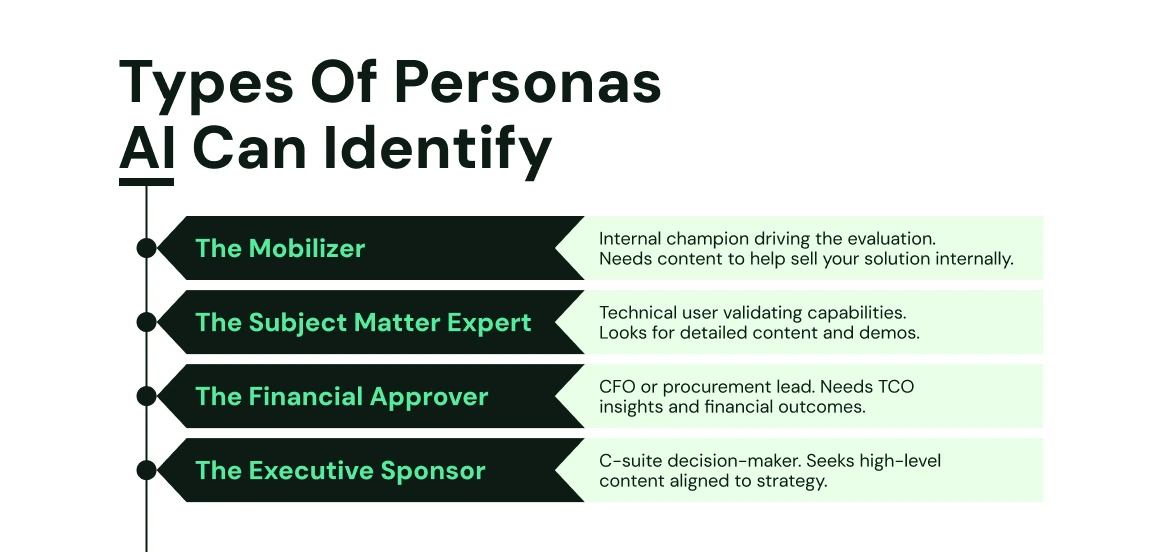
For each identified persona, a different messaging track can be deployed. This level of nuanced targeting, scaled across hundreds of accounts, is impossible without an AI-driven system. It replaces strategic ambiguity with a data-driven blueprint for building consensus.


Get new reports and insights from KKBC by email.
 US
US 

 US
US 